How To End Piracy


Photo by: peasap

All the talk of people pirating music — and movies, and software — is enough to make you think it’s a hard problem to solve. But it’s not, really. All you have to do is disincentivise copying. (That’s sarcasm, for those who missed it.)

The MPAA and RIAA have tried licensing, lawsuits, lobbying (I didn’t do that on purpose, I swear) but the copying doesn’t stop. People are amoral thieves!

Or … maybe people remember that when the compact disc format came out, it was supposed to be cheaper than cassettes. They cost less to produce, so as soon as the studios recouped the cost of building the new technology we’d see prices drop. It’s been over 27 years now, have they recouped that investment yet?

Apple to the Rescue

Continue reading How To End Piracy

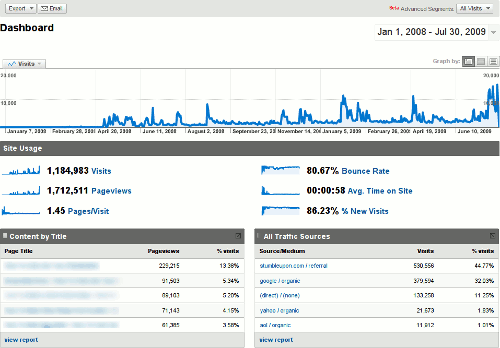
How To Make $200 / Hour Doing Web Analytics

If you plan to make $200 per hour doing something, you first need to believe that someone is willing to pay that much for what you do. So what makes web analytics worth $200 per hour? Convincing people that you’re worth that much is your second challenge. Your first challenge is convincing someone they need to pay someone to do web analytics at all.

This isn’t a new problem. Kevin Kelly talks about the changing network effects in different phases of the evolution of all new markets:

Maximizing the value of the net itself soon becomes the number one strategy for a firm. For instance, game companies will devote as much energy to promoting the platform—the tangle of users, game developers, and hardware manufacturers—as they do to their games … During certain phases of growth, feeding the network is as important as feeding the firm.

What he’s saying is that people have to want a game before they can want your game. It’s the same with analytics. People have to want analytics services before they can want your analytics services.

Do Not Want!

Web analytics suffers from the same issues as copywriting: Everyone thinks they can write, so they don’t value good writing. Same with analytics. Anyone can read charts on Google, and with a couple of days practice you can even set up split tests. What do you need to pay someone for?

The consultants already making money at it will tell you that that yes, anyone can optimize a site with enough testing. What you’re paying the big bucks for is someone who can skip past two months of split testing and show results in the first week. Some people are that good. Identifying them out of all the ones claiming to be that good is hard.

Your challenge in getting clients is mostly going to be convincing them the service can have a large impact. Large companies already know this. That won’t help you, because they already have people doing it.

That leaves small businesses. There’s a ton of opportunity for small businesses to use an analytics consultant. Convincing them of that is the hard part. Do you plan on cold-calling small businesses? How will you get leads? What’s your pitch going to be?

Oh, you don’t want to be a salesman? You don’t want to sell yourself that way? Sorry then, I guess I can’t tell you how to make $200 per hour doing analytics after all.

Who Wants a Netbook?


Photo by: zieak

I know what I want a netbook for. First I’m a guy, and it’s a gadget, and it’s just cool as hell. So yeah, I want an expensive toy. But beyond that, it’s something that’s small enough I can take it with me almost anywhere and get some work done. It’s more capable than a smartphone at all of the non-phone things. (And by the way, I still want a plain old phone that just makes calls and stores phone numbers. Can I buy that, please?)

But I don’t understand who the target market is

What Do They Do?

The iPhone does things no other cellphone did, in a form factor that lets you bring it places you wouldn’t bring a laptop. So no matter which you compare it to, there’s something the iPhone does that was unique.

What does a netbook do that’s unique? It’s smaller than a laptop, but not so much so that you’ll throw it in your pocket and have it always with you. You can, but you won’t, it’s just a bit too big for that.

It’s more usable than a phone, with a more human-scale user interface, but not as usable as a sub-notebook.

That leaves … playing DVDs? And games? When I said I wanted a toy I didn’t mean that’s all I thought it was good for. But now I’m not so sure. Where would I realistically want to have a computer, that I could have a netbook, that I wouldn’t want to have a laptop?

I’m coming up blank here.

You Are Not Special


Photo by: Ethan Hein

Everybody wants to think they are a unique and special snowflake. And they are … in a blizzard of other unique and special snowflakes.

If I seem to be going a little Tyler Durden here, it’s because I am sick to death of people assuming that the challenges they face are unique. That no one else in the history of the world has ever faced quite what they face. And in particular, that working in IT is just so completely different from every other profession out there. Despite the fact that they’ve never worked in any other profession, and don’t realize it’s the same everywhere.

“Technical Debt” … AKA Taking Shortcuts

People who write code for a living have a very specialized vocabulary, just like every other profession. And just like in every other profession, knowing the lingo is a screening tool to separate “us” from “them”. But people immersed in the vocabulary every day don’t know that they’re using jargon to describe a well-known concept.

Take technical debt. People in IT write articles arguing whether it exists or not, what to do about it, how stupid managers are for allowing it to build up. But all it means is that if you take a shortcut today, at some point in the future you’re going to have to pay for it, and it will probably cost more when you do. Yes, this is exactly what Fram was talking about when they said, “You can pay me now, or you can pay me later.

It doesn’t sound so impressive once you realize they’re just copying an old commercial, does it?

“Arbitrary Skill Lists” … AKA Weeding Out Resumés

Job listings in IT tend to be full of acronyms, and list how many years you should have worked with each technology. These lists are “unreasonable” and “arbitrary”. And exactly the same as job listings in every other industry.

What does a degree in Art History have to do with being an office manager? Not a damn thing, but you need “a college degree” to get in the door. Any old degree is fine.

And four or more years of experience with this specific vendor’s purchasing system, which has only existed for four years, is “preferred but not required”.

Oh, and Clarity for project management.

And Peoplesoft for HR.

And SAP.

And Oracle Forms.

And Sharepoint.

And this is for the entry-level admin assistant job. The Office Manager job has already been promised to the current admin assistant, but HR says they have to advertise the opening anyway.

Same as it Ever Was

Sure, there are things about every industry and segment that are unique to that area. But it’s not nearly as much as people seem to think. Odds are whatever you’re thinking is unique really isn’t. It’s the things you do every day without thinking about them that set you apart.